For synthetic biology labs
Free ELN software for synthetic biology labs
Updated October 2026
TeselaGen is ELN software built around DNA and protein sequences. Notebook entries link to the sequences, parts and assembly protocols they describe, and everything exports as JSON, CSV, FASTA or GenBank. TeselaGen Community gives academic labs, students, iGEM teams and early-stage startups the notebook, sequence tools and DNA assembly design for free, so sequences and experiments live in one place from day one.
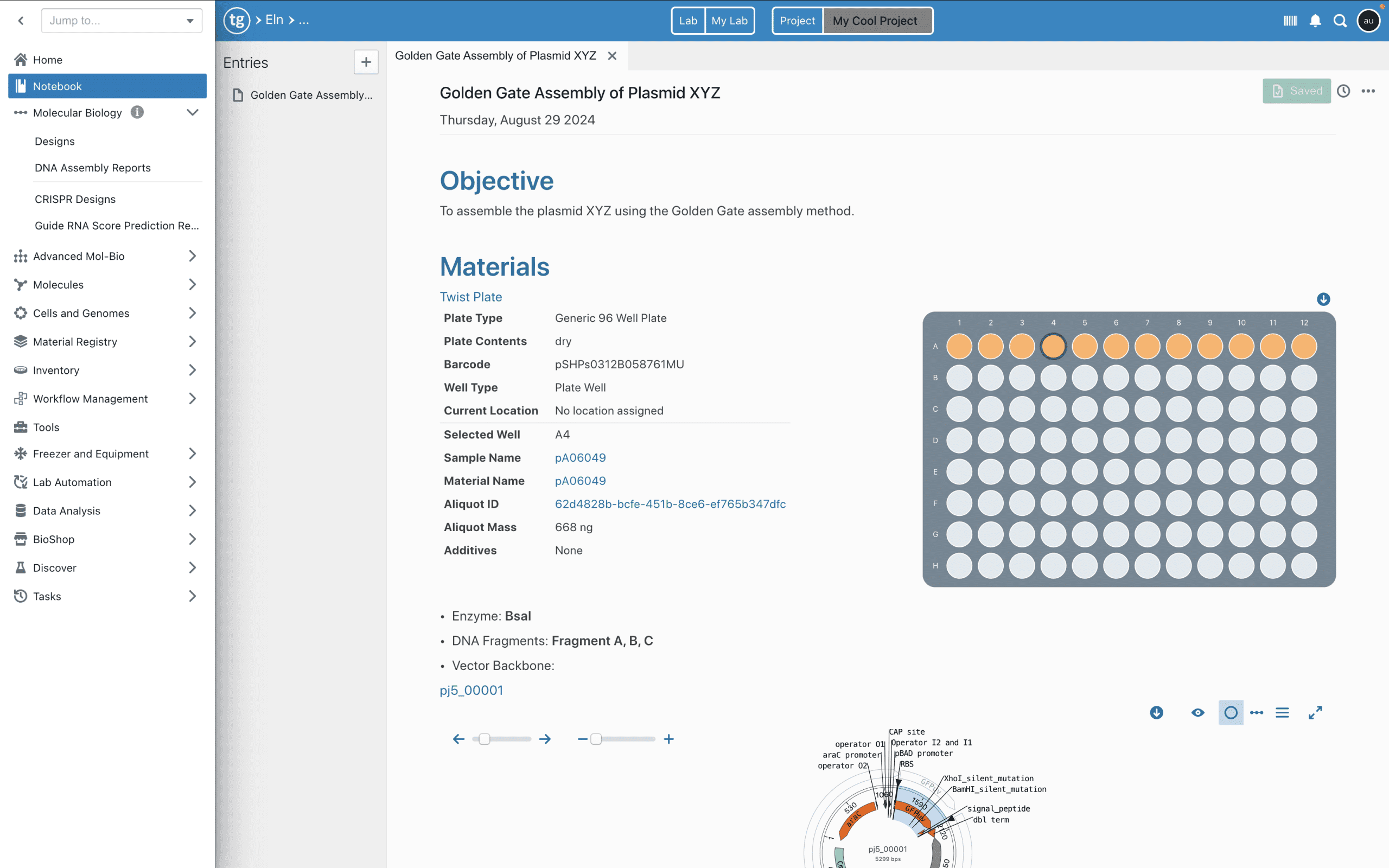
What can a synthetic biology lab do for free in TeselaGen Community?
A synthetic biology lab can run its notebook, sequence library and DNA assembly design in TeselaGen Community at no cost. Community includes:
- Electronic lab notebook with templates, data tables and linked sequence records
- Sequence editor with plasmid maps, annotation and alignments
- Sequence and parts library for DNA and protein sequences
- DNA assembly design (Gibson, Golden Gate, MoClo, USER, PCR) with automatic assembly protocols
- Primer design, plus Twist and IDT order forms
- Digest design, CRISPR knock-in design and gRNA scoring
- TeselaGen CoScientist, the AI assistant inside the platform
- The REST API
Community does not include inventory and the material registry, workflow management, lab automation, freezer and equipment management, or Discover (machine learning on experimental data). Those are on paid plans, and each section below says which plan a capability needs.
What should ELN software for synthetic biology do?
ELN software for synthetic biology should store experiments as structured records that link to the sequences, parts and samples they describe, not as free text. An electronic lab notebook (ELN) is the system where researchers plan, record and sign off on experiments; in a synthetic biology lab, most of those experiments are about DNA and protein sequences.
In TeselaGen, a notebook entry can hold rich text, images, attachments, data tables and spreadsheet blocks. Typing @ inserts a live link to a sequence, sample or other record, so the entry and the design stay connected.
- Workspace template library, so every group records the same experiment the same way
- Version history with restore, and copying an entry to start the next run
- Real-time editing by several authors, with live cursors
How does TeselaGen handle DNA and protein engineering data?
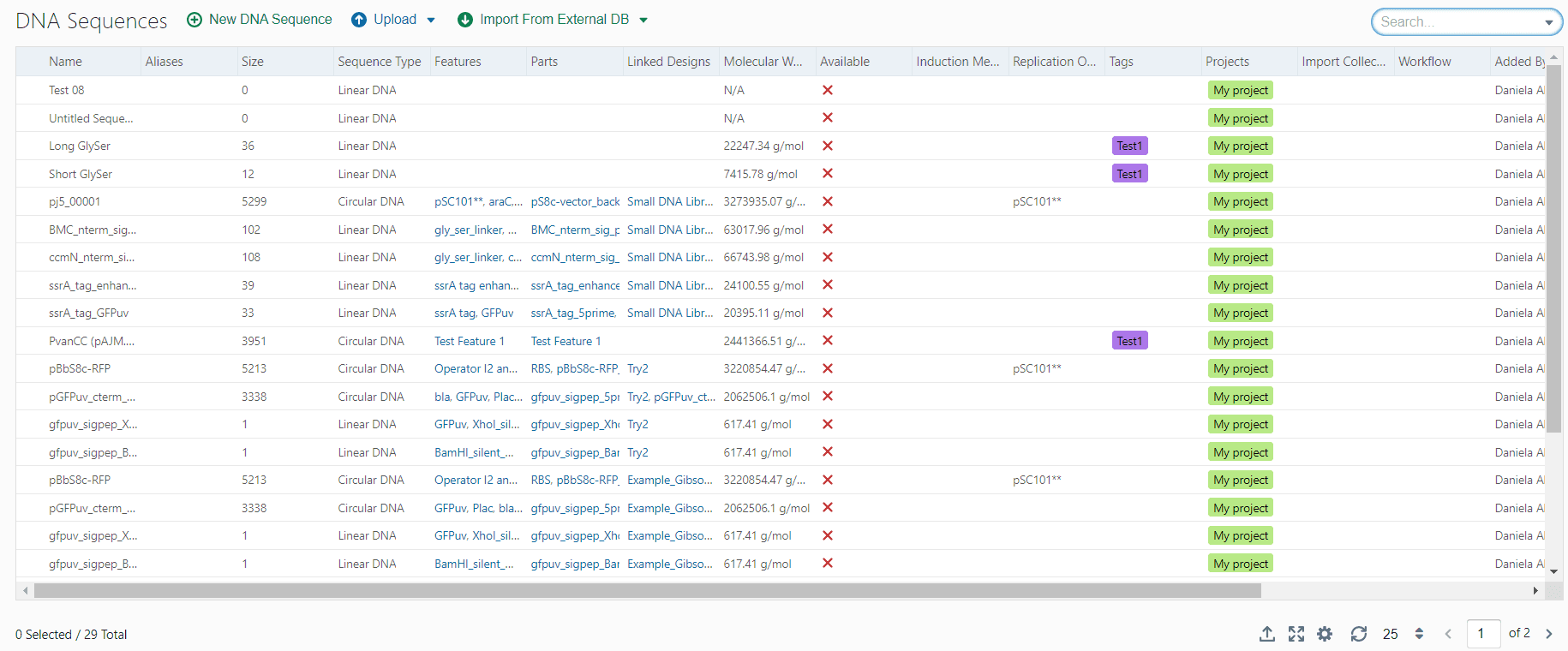
TeselaGen stores DNA and protein sequences as first-class records with their annotations, so notebook entries, designs and exports all point at the same sequence. Sequences can be imported as GenBank, FASTA or SnapGene files. GenBank is the annotated sequence file format used by NCBI and most sequence tools.
- DNA: features, parts and primers, automatic annotation from your workspace libraries, pairwise and multiple alignments, and sequence version history
- Protein: amino acid sequences with molecular weight, isoelectric point, extinction coefficient, His-tag location, UniProt ID and region annotations
- Amino acid parts and part sets, multi-domain functional protein units, and reverse translation to DNA
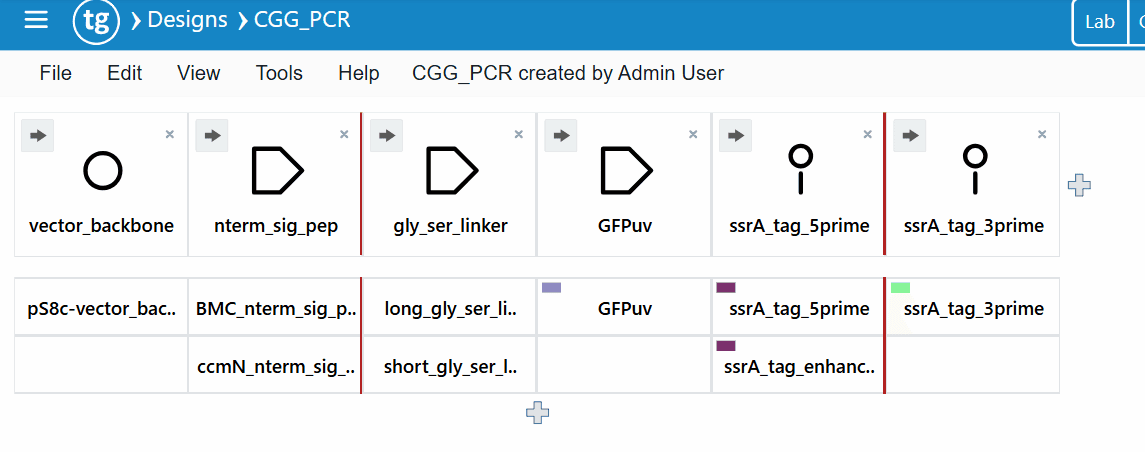
Can TeselaGen take a DNA library design from design to build?
Yes. You design a combinatorial or hierarchical DNA library from parts, TeselaGen validates it, and it generates an assembly protocol with build instructions for Gibson, Golden Gate, MoClo, USER or PCR assembly. Running the assembly saves the primers, oligos and assembled constructs back into your workspace libraries, where notebook entries can link to them.
Community includes assembly design with automatic assembly protocols. Turning a design into plate maps and liquid-handler worklists is part of lab automation, which is on paid plans.
How do you export R&D data in JSON, CSV, FASTA and GenBank?
TeselaGen exports each kind of record in an open format: notebook entries as JSON or PDF, tables as CSV, DNA sequences as GenBank, FASTA, JSON or CSV, and protein sequences as GenPept, FASTA or JSON. Exports run from the record or list you are looking at; the notebook exports one entry at a time.
For bulk or scheduled exports, the REST API reads and writes the same data, including notebook content, on every plan, Community included. Before you commit years of work to any ELN, export a real entry and import it again to confirm the round trip keeps what you need.
| Record | Export formats | Notes |
|---|---|---|
| Notebook entries and templates | TeselaGen JSON, PDF | JSON re-imports into another project or workspace; signed entries export the signed record |
| Tables inside an entry | CSV, or embedded in the PDF | Choose CSV attachments, PDF tables, or both |
| DNA sequences | GenBank, FASTA, TeselaGen JSON, CSV | Single sequences or a bulk selection from the library |
| Protein (amino acid) sequences | GenPept, FASTA, TeselaGen JSON | GenPept is the GenBank format for proteins |
| Library tables and assay data | CSV | Features, tags and other library lists; data grids export the table as CSV |
Can several research groups collaborate in one ELN?
Yes. TeselaGen organizes data into workspaces: a workspace can have many members with owner-managed invitations and roles, and a researcher can belong to several workspaces and switch between them. Projects inside a workspace group related records, and access follows project and workspace membership.
Each group can keep its own workspace while people who work with several groups switch between them, so a department or consortium does not need one shared account to collaborate.
- Records belong to the active workspace, so each group keeps its own data
- Moving entries between workspaces works through JSON export and import
Can you run machine learning on your experimental data?
Yes, on paid plans. TeselaGen Discover trains predictive models on your own assay data, such as titer or binding affinity, then recommends ranked variants and proposes new protein sequence candidates for the next round. Candidates can be promoted to part sets and sent back into design, and results export as CSV.
Machine learning only works when experiments were recorded as structured, linked data in the first place, which is why the notebook and sequence library matter even before you train anything.
Does TeselaGen work with lab automation?
Yes, on paid plans. TeselaGen generates worklists for Echo, Tecan, Hamilton and Biomek liquid handlers as CSV or TXT files, plans plate placement, and runs sequencing QC that aligns reads to the reference and lets you approve or reject each construct.
Workflow management connects notebook entries to that execution, and instrument files, CSV and Excel exports load into data grids as assay results.
Does TeselaGen also track samples and inventory like a LIMS?
Yes, on paid plans. A LIMS (laboratory information management system) tracks samples, materials and storage locations; in TeselaGen that is the registry and inventory toolkit, plus freezer and equipment management. Notebook entries can then link to the physical samples as well as the sequences.
When is TeselaGen not the right fit?
TeselaGen is not the right fit if you need a vendor-supplied validation package or an on-premises install. There is no published GxP validation package: TeselaGen supports 21 CFR Part 11 workflows with e-signatures on paid plans, but validating the system for GxP use is your own project. TeselaGen is also not self-hostable.
Before you choose any ELN, check three things:
- Export a real entry and import it again, and confirm nothing you need is lost.
- List the features you need and confirm which plan includes each one.
- Decide whether you need signed, locked records now or later.
How does TeselaGen compare with other ELNs for synthetic biology?
Start with the synthetic biology ranking, then use the buyer's guide to weigh the criteria for your own lab.
Which TeselaGen plan fits your lab?
Most synthetic biology labs can start on Community and add paid features when they need them.
Start free with Community
For academic labs, students, iGEM teams and early-stage startups: keep your sequences, designs and notebook in one place at no cost.
Start free with CommunityNeed lab automation, machine learning or inventory?
Paid plans add lab automation, Discover for machine learning on experimental data, inventory and the material registry, and workflow management.
Talk to us about paid plansFrequently asked questions
Is there a free ELN for synthetic biology labs?
Yes. TeselaGen Community is a free electronic lab notebook for synthetic biology that also includes a sequence editor, a sequence and parts library, DNA assembly design with automatic assembly protocols, primer design, CRISPR design and TeselaGen CoScientist. Lab automation, machine learning on experimental data, inventory and workflow management are on paid plans.
What is the best ELN software for academic synthetic biology labs?
The best ELN software for an academic synthetic biology lab treats DNA and protein sequences as structured records, exports them in open formats such as GenBank and FASTA, and fits an academic budget. TeselaGen Community covers those three needs at no cost, and academic groups that outgrow it can ask about educational pricing.
Can I fully export experiments in JSON or CSV?
Yes. TeselaGen exports each notebook entry as JSON or PDF, tables inside an entry as CSV, and sequences and library tables as CSV, while the REST API reads the same data for bulk exports. The notebook exports one entry at a time, so test a round trip with a real entry before you migrate.
Which ELN handles protein engineering data and exports FASTA and GenBank?
TeselaGen stores protein sequences with their properties and annotations and exports them as FASTA, GenPept (the GenBank format for proteins) or JSON, and exports DNA sequences as GenBank, FASTA, JSON or CSV.
Does TeselaGen support DNA library design?
Yes. TeselaGen designs combinatorial and hierarchical DNA libraries for Gibson, Golden Gate, MoClo, USER and PCR assembly, validates them and generates an assembly protocol. Assembly design is included in Community; liquid-handler worklists are on paid plans.
Which ELN supports machine learning workflows on experimental data?
TeselaGen does, on paid plans: Discover trains predictive models on your assay data and recommends ranked variants and new protein sequence candidates for the next design round. Results export as CSV, and customer data is not used to train third-party language models.
Can multiple research groups collaborate in TeselaGen?
Yes. TeselaGen uses workspaces with owner-managed invitations and roles, researchers can belong to several workspaces, and notebook entries support real-time editing by several authors. A workspace can have many members, and each group can keep its own workspace.
Does TeselaGen work with lab automation in synthetic biology?
Yes, on paid plans. TeselaGen generates CSV or TXT worklists for Echo, Tecan, Hamilton and Biomek liquid handlers, plans plate placement and runs sequencing QC on assembled constructs.