The backbone for AI-native biology
Your AI is only as good as your lab's memory.
TeselaGen keeps every sequence, sample, protocol and result connected: how it was designed, how it was built and what it produced. Your team, your code and any AI agent work from the same history.
Powering the world's labs pushing science forward
bitBiome
TWISTBIOSCIENCE
AMGEN
Stanford
HARVARD
MIT
UC Berkeley
UCSF
Penn
CSIRO
INSTITUTPASTEUR
Berkeley Lab
jbei
TaKaRa
One record
Anyone can build an AI agent now. Few labs have the history to make it useful.
Agents get cheaper every month, and many teams build their own. What no agent can generate is your lab's history: what was designed, how it was built, where it went and what it measured. TeselaGen keeps that history in one workspace, for your scientists and for every agent they bring.
Built for biology01 / 05
Generic AI writes code. These tools do the biology.
Years of engineering and lab validation sit behind each one. Your scientists use them in the app, your agents call them through the MCP server, and what they produce lands in the record.
See all nine toolkitsDesign and editingAgent-callable
Edit and annotate sequences, keep reusable parts, manage restriction sites and align what comes back from the bench.
Molecular Biology ToolkitAssembly planningAgent-callable
Combinatorial and hierarchical designs become build instructions, validated as you work and drawing on parts you already have.
Combinatorial library designGenome engineering
Guide design with on-target and off-target scoring, knock-in and homology arm design, and every edit tracked from parent to child.
Gene editing toolsOptimized to manufactureAgent-callable
Codon optimization for your host, long sequences split into fragments you can actually synthesize, and build instructions costed before you order.
Advanced Molecular Biology ToolkitOptimized for phenotype
Synthetic Evolution® learns from every round of results and recommends the designs worth building next.
Discover ToolkitBuild and verify
Order parts, run the worklists your instruments expect, then load chromatograms and plate reads back onto the construct they came from.
Lab Automation ToolkitSamples, data and lineage02 / 05
Every result traces back to the design that produced it
Samples, plates, strains and sequences stay linked as the work moves. Measurements land on the well they came from, so every result knows where it came from and how it was made.
Learn morePL-000142GG-LIB-01
A1–A3
A1A2A3
| Well | Construct | GFP/OD600 ×10³, 16 h | GFP/OD600 ×10³, 24 h |
|---|---|---|---|
| A1 | pTG-J23100-B0034-sfGFP | 12.9 | 13.6 |
| A2 | pTG-J23100-B0032-sfGFP | 4.0 | 4.4 |
| A3 | pTG-J23100-B0030-sfGFP | 9.3 | 9.9 |
Lineage
Transformation, conjugation and genome edits link each child to its parent and plasmid.
Re-array
Top hits to retest plates with a worklist. New sample IDs, same ancestry.
Measurements
Plate reads and assay files load as data tables and attach to each well, ready to analyze or plot from the plate, sample or sequence.
Notebook and workflows03 / 05
Write it down once. Everything else stays attached.
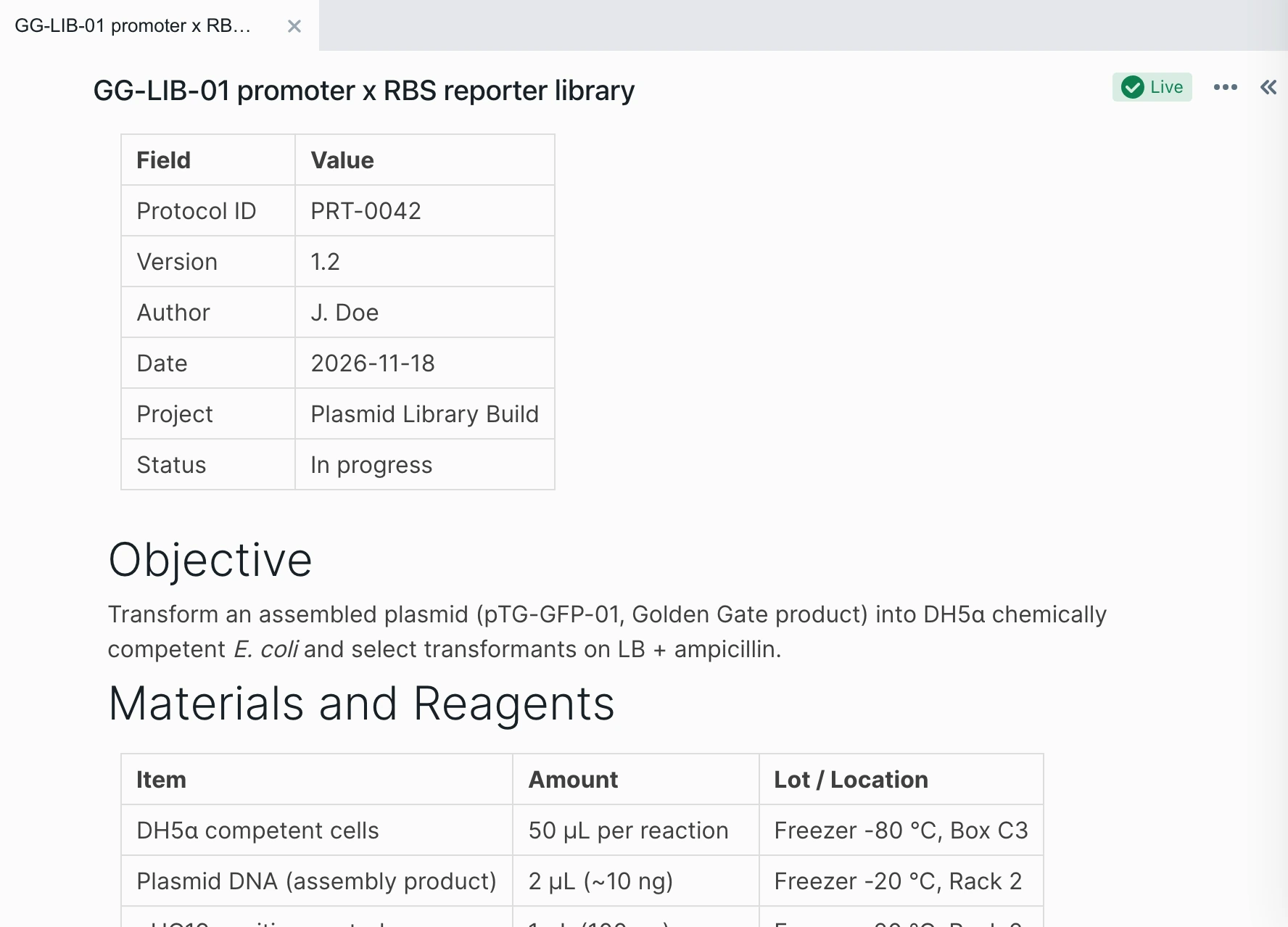
Reference a construct, a plate or a sample inside an entry and the link holds. Your team edits the same page at the same time, and any agent you connect works from the same record you do.
Learn more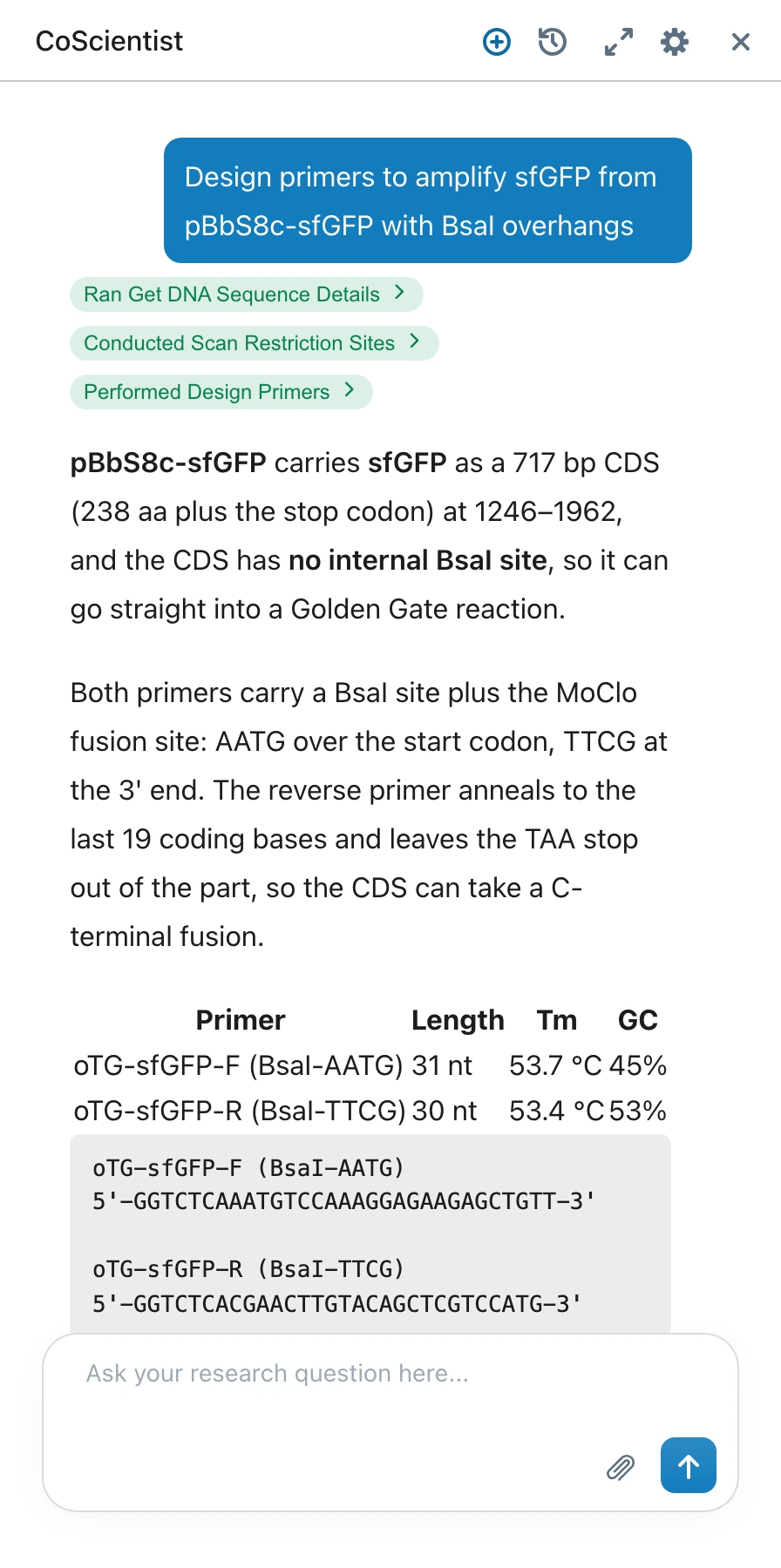
Linked records
Type @ to reference a sequence, strain, plate or sample. The mention opens the record itself.
Workflows
Lay the steps out once, then start a run and track it step by step.
Versions and signing
Every change is kept and any earlier version can be restored. Sign the entry when the work is complete.
Bring your own agents04 / 05
Build your own agents on top. We've built what they need underneath.
Connect Claude, ChatGPT, Cursor or an agent your team wrote through the MCP server or the REST API. They work from the same records as your scientists, and what they produce is saved back to the record it belongs to. Your own scripts run there too.
Learn moreSource CodeLast OutputLast Error none
Asked CoScientistNormalize GFP by OD600, subtract the media blanks in column 12, and score each well against the positive control.
# normalize_gfp_od.pyimport pandas as pd def run(plate): df = plate.results(["GFP", "OD600"]) # one row per well blank = df[df.contents == "media"].mean(numeric_only=True) df["gfp_od"] = (df.GFP - blank.GFP) / (df.OD600 - blank.OD600) ctrl = df.loc[df.contents == "pBbS8c-sfGFP", "gfp_od"].mean() df["relative"] = (df.gfp_od / ctrl).round(2) return df[["well", "contents", "relative"]]RecordDataLast Output
Run on PL-000142Output attached
PL-000142GG-LIB-01, 16 h read
WellsResultsCustom tool output 1
normalize_gfp_odLast OutputJR
GFP / OD600, relative to positive control01.2
A1pTG-J23100-B0034-sfGFP1.04
| Well | Contents | Relative |
|---|
MCP server
Connect TeselaGen to the AI assistants your team already uses.
REST API
Read and write workspace records from your own scripts and pipelines.
Integrations
Lab automation, synthesis providers, ELNs and public databases, connected to the same workspace.
Works with the tools you already use
All integrationsTeselaGen works with AI assistants (Claude, Claude Code, ChatGPT, Cursor and any MCP client), records and databases (GenBank, UniProt and any ELN or LIMS), DNA synthesis providers (Twist Bioscience, IDT and Elegen) and lab automation (Echo, Tecan, Hamilton, Biomek, Mantis and QPix).
- AI assistants: ClaudeAI assistant
- Claude CodeCoding agent
- ChatGPTAI assistant
- CursorCode editor
- Any MCP clientMCP
- TeselaGenWorkspace
- Records and databases: GenBankDatabase
- UniProtDatabase
- Any ELN or LIMSRecords
- DNA synthesis: Twist BioscienceSynthesis
- IDTSynthesis
- ElegenSynthesis
- Lab automation: EchoWorklists
- TecanWorklists
- HamiltonWorklists
- BiomekWorklists
- MantisWorklists
- QPixColony picker
MCP server
Add TeselaGen to an AI assistant with one command.
claude mcp add --scope user --transport http teselagen "https://mcp.teselagen.com/mcp"CoScientist05 / 05
No AI team? CoScientist comes included.
Describe the library in one sentence. CoScientist finds the parts in your workspace, builds the design and returns a build ready assembly protocol, working from the same record as your team. Free in Community Edition.
Learn moreFrom one prompt to an assembly protocol
Prompt
Ask in plain language
Describe the library you want in one sentence.
Step 1
Finds your parts
Searches your workspace for the parts and the backbone.
Step 2
Builds the design
Lays out every combination of the parts you named.
Step 3
Runs the assembly
Submits the design and reads back the protocol.
Impact
Impact that you can measure.
7x
Increase in design & build speed
10x
Reduction in development costs
2x
Increase in production rate & titer
Customers
Trusted by leading biotech teams
“Our AI platform designs enzymes and strains from our proprietary data that cannot be found in the public databases. Turning those designs into results for our partners depends largely on how efficiently we can test those designs in the lab. TeselaGen gave us a platform our scientists could shape around their own workflows, and a team that moved at our pace.”

Yuji SuzukiCEO, bitBiome
“We love the interaction between Twist and TeselaGen. Together we get speed, lower cost, integration, and security. At the end you get a much lower cost per data point.”

Emily LeproustCEO, Twist Bioscience
“We’re looking forward to working with TeselaGen to streamline information flow throughout fermentation processing.”

Deepti TanjoreDirector, ABPDU
“Improvements in automation and software allow us to bring the cost barrier down. We’re no longer limited by cost; we’re just limited by creativity.”

Michael MagaraciDirector of Platform, Protein Evolution
“Automated biological design is an essential foundation for our carbon recycling technology. TeselaGen has a reliable platform for modern industrial DNA design and cloning.”

Dr. Michael KöpkeVP Synthetic Biology, LanzaTech
Start free
Start free. Grow with your team.
From one researcher to a global R&D organization, your lab's record grows with you, and every tool you connect starts from everything you've already done. See pricing