Type IIS assembly for individual researchers, academic labs and small teams
Free Golden Gate assembly design software for academic labs
Updated October 2026
TeselaGen Community is free Golden Gate assembly design software. Place your parts and backbone in bins, choose the Type IIS enzyme, and TeselaGen designs primers that add the recognition site and overhang to each part, then generates an assembly protocol you can take to the bench.
What does TeselaGen Community include for Golden Gate assembly?
Community covers Golden Gate design from parts to assembly protocol, for one construct or a set of variants, at no cost:
- Golden Gate assembly design with BsaI, BsmBI, BbsI or another Type IIS enzyme
- An assembly protocol for each design you submit, with the overhang every assembly piece shares with its neighbors
- Combinatorial designs, with alternative parts in a bin
- DNA Assembly from Digest, which builds a design from digest parts by matching their overhangs
- Gibson assembly design in the same editor
- Built-in ordering tools for the oligos and fragments in your assembly protocol
- TeselaGen CoScientist, the AI assistant that can lay out a design from your parts list
Which free software plans Golden Gate assemblies and generates the assembly protocol?
TeselaGen Community plans Golden Gate assemblies for free: you place the parts in bins and choose the Type IIS enzyme, and it designs the primers and generates the assembly protocol for the whole build.
The design, its oligos and the finished constructs stay together in your workspace. Swap a part and resubmit, and TeselaGen works out the primers and overhangs for the whole design again.
Which Type IIS enzymes and overhangs can I use in TeselaGen?
You can use any Type IIS enzyme with a fixed recognition site, including BsaI, BsmBI and BbsI: choose it when you set the method to Golden Gate, and TeselaGen sets the recognition site and overhang length from it. With BsaI that is GGTCTC and a four-base overhang.
The method and enzyme live in the Assembly Reaction Details panel of the design inspector. At a junction with a digest part, you can specify the overhang bases yourself, so a design can follow your lab's own overhang standard.
Before you submit, find internal sites for your enzyme with the cut-site view of the sequence editor and edit the source sequence.
Does TeselaGen check Golden Gate overhangs as I design?
Yes, on digest parts. For parts you prepare by digest, the design editor warns when an overhang is self-complementary or does not match its neighbor.
The check runs again on every edit, so you can fix a mismatched overhang before you submit.
What is in the Golden Gate assembly protocol TeselaGen generates?
The Golden Gate assembly protocol shows the overhang each assembly piece shares with the previous and the next piece, together with the oligos that add the Type IIS sites, the PCR reactions and the finished constructs.
Build the oligo and fragment orders with the built-in ordering tools, or download the oligo list as CSV.
For a coding fusion, pick overhang bases that keep the reading frame and review the translation of the assembled construct in the sequence editor; TeselaGen does not check the reading frame across an overhang.
Can I plan a library of Golden Gate variants instead of one construct?
Yes. In TeselaGen a bin can hold alternative parts, and the assembly protocol lists each resulting construct.
The protocol's Multiplicity column shows how many constructs use each assembly piece, so you can see which pieces to prepare once and reuse.
Can TeselaGen CoScientist lay out a Golden Gate design for me?
Yes. Tell TeselaGen CoScientist which parts go in each position, alternatives included, and it creates a Golden Gate design with those bins in the design editor.
It can also submit the design for assembly and tell you when the assembly protocol is ready, or you can open the design first and change the enzyme, a bin or a part.
From Claude or an IDE, you sign in to the TeselaGen MCP server with OAuth, and the assistant can find a design by name, read its bins and parts, and submit it for assembly.
| Step | Community (free) | Enterprise |
|---|---|---|
| Design the assembly with your Type IIS enzyme and overhangs | Included | Included |
| Combinatorial variants in a single-level design | Included | Included |
| Generate the assembly protocol with each piece's overhangs | Included | Included |
| Build oligo and fragment orders from the assembly protocol | Included | Included |
| PCR, USER and other assembly methods; multi-level designs that combine Golden Gate products into larger constructs | No | Advanced molecular biology |
| Track reagents, samples and the plates that hold your parts | No | Inventory, material registry, freezer and equipment management |
| Run assembly reactions on a liquid handler from worklists | No | Workflow management and lab automation |
| Machine learning on the variants you screen | No | Discover |
Who is TeselaGen Golden Gate assembly design software for?
TeselaGen Golden Gate assembly design software is for researchers who assemble standardized parts with a Type IIS enzyme and want the primers, overhangs, assembly protocol and parts library in one workspace.
- Labs assembling standardized parts with BsaI, BsmBI, BbsI or another Type IIS enzyme
- Teams swapping promoters, RBSs or terminators across a set of constructs
- Groups preparing parts by digest who want overhang mismatches flagged while they design
- Researchers who want design, assembly protocol and notebook in one workspace
How do I get started?
TeselaGen Community is free to start. The Enterprise features listed above come with TeselaGen Enterprise.
Start free with Community
Lay out your next Golden Gate build and get its assembly protocol in TeselaGen Community.
Start free with CommunitySupporting several labs or a core facility?
Enterprise runs the same design editor for larger teams and facilities.
Compare plans and pricingFrequently asked questions
Can an academic lab use TeselaGen Golden Gate software at no cost?
Yes. TeselaGen Community, the free edition for individual researchers, academic labs and small teams, plans Golden Gate assemblies and generates an assembly protocol for each design.
Can I save my Golden Gate settings for the next design?
Yes. Save the reaction's method, enzyme and assembly parameters with Save Current Reaction Template as Preset, then use Load Reaction Template in any later design.
Can I build a Golden Gate design from parts I have already digested?
Yes. DNA Assembly from Digest takes your digest parts, places the vector backbone in the first bin and orders the other parts by matching their overhangs, which gives you a Golden Gate design ready to submit.
Can a short part such as an RBS come from annealed oligos instead of PCR?
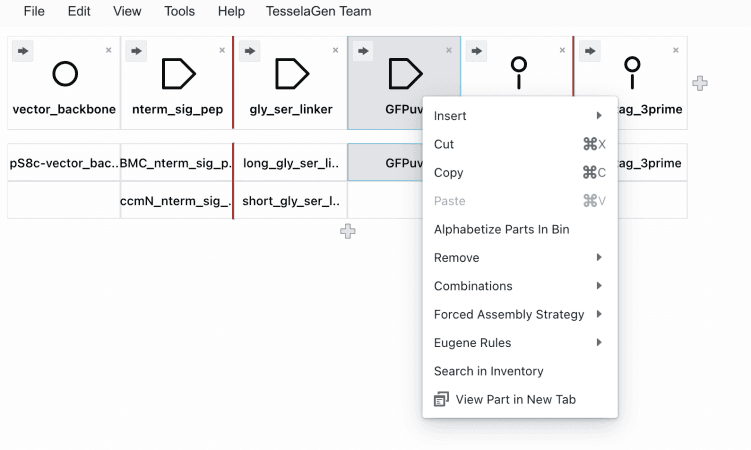
Yes. Set the part's forced assembly strategy to Annealed Oligos from the bin's context menu, or to Direct Synthesis for a longer part, and the assembly protocol plans it that way instead of as a PCR product.
Can I control how TeselaGen names the constructs and oligos it creates?
Yes. Naming templates in the Assembly Reaction Details panel set the names of the assembled constructs, oligos, DNA synthesis pieces, PCR reactions and assembly pieces for each reaction.
Does the same design editor plan Gibson assemblies too?
Yes. Switch the assembly method to Gibson/SLIC/CPEC and TeselaGen joins the same parts with homology overlaps carried on primer tails, with no Type IIS sites to add.