For synthetic biology and biotech R&D teams
Combinatorial DNA library design software
Updated October 2026
TeselaGen is combinatorial DNA library design software: you define the parts that can fill each position of a construct, TeselaGen shows how many combinations the design makes, and it turns the design into an assembly protocol with the primers and oligos your method needs. Library design and assembly protocols are included in TeselaGen Community, the free edition for individual researchers, academic labs and small teams.
What does TeselaGen Community include for combinatorial library design?
TeselaGen Community includes the design grid, Gibson and Golden Gate assembly design, assembly protocols with primers and oligos, and the sequence tools around them.
- A combinatorial design grid where each column is a position and each row a part choice, with the number of possible combinations shown as you build
- Gibson and Golden Gate assembly design, with warnings when a digested part's overhang is self-complementary or does not match its neighbor
- An assembly protocol generated from the design, with the primers and oligos the method needs
- A sequence editor and sequence library with digest and annotation tools, plus the built-in ordering tools to build orders for IDT (oligos and double-stranded DNA fragments) and Twist (DNA fragments and clonal genes)
- TeselaGen CoScientist, the AI assistant, plus integrations
What is combinatorial DNA library design?
Combinatorial DNA library design is the practice of defining several interchangeable options for each position of a construct, such as promoters, coding sequences and terminators, and building the combinations as one planned library instead of one construct at a time.
The design is the source of truth. Once the positions and options are fixed, the number of variants, the parts to source and the assembly steps follow from it, which is what makes a library reproducible and easy to hand to a bench team or an automation platform.
What is the best software for designing combinatorial DNA libraries?
TeselaGen is built for combinatorial library design: it lays the library out as a grid of positions and part choices, counts the combinations and generates the assembly protocol with primers and oligos.
What sets a library design tool apart from a sequence editor is that the design stays structured from start to finish. In TeselaGen the grid is the design, so the variant count, the junctions and the protocol all come from one place. The design sits in the same platform as your sequence library and electronic lab notebook, so parts, protocols and results stay connected from one library round to the next.
How does TeselaGen design a combinatorial DNA library?
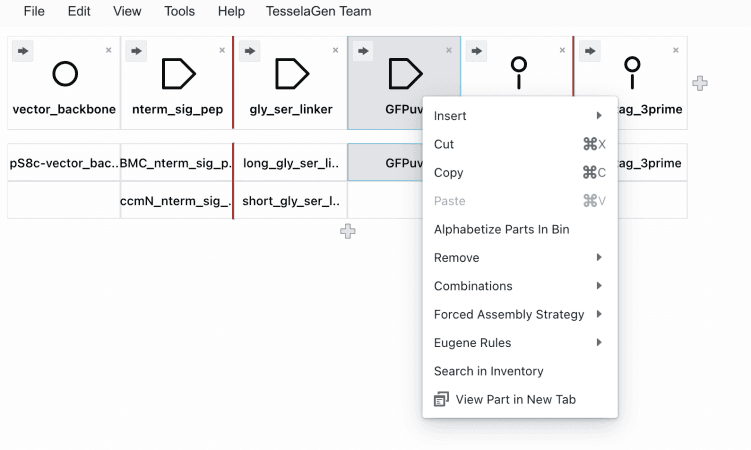
TeselaGen lays the library out as a grid in its design editor: each column is a bin, meaning a position in the construct, and each row is a part choice for that position.
You drop in sequences or parts from your sequence library, label bins with standard part types and choose Gibson or Golden Gate as the assembly method. The reaction panel shows the number of possible combinations, and for parts prepared by digest the editor warns when an overhang is self-complementary or does not match its neighbor. The design is saved after every edit.
How do I get an assembly protocol for a combinatorial library?
Submit the design for assembly and TeselaGen returns an assembly protocol for the library: the steps to build each construct, with the primers and oligos the chosen method needs.
Because the protocol comes from the design, changing a part or adding a row and resubmitting generates a new assembly protocol from the updated design. The protocol lists the constructs, assembly pieces and oligos, and the primers are designed to the assembly method you chose.
With the TeselaGen MCP server, you sign in from Claude or another Model Context Protocol (MCP) client, and the assistant can find a design, submit it for assembly, check its status and read any errors or warnings, with the constructs they affect.
Can I design hierarchical DNA libraries with TeselaGen?
TeselaGen designs hierarchical libraries with its advanced molecular biology toolkit: intermediate assemblies feed larger ones, and each level appears as a card in a tree.
Long constructs are broken into submodules that are built and reused separately. The same toolkit adds rulesets that check part tags and sequence rules, schematics, parallel part design from alignments, and sequence partitioning.
How do library designs connect to liquid handling automation?
In TeselaGen, workflow management plans the library from its assembly protocol onto plates, and the lab automation toolkit exports worklists for liquid handlers such as Echo, Tecan, Hamilton and Biomek.
The design defines what to build and the worklist tells the liquid handler which transfers to make, so the plates on the deck match the library you designed.
How do the results of one library round shape the next design?
TeselaGen's Discover toolkit learns from the measured results of a library round and suggests which variants to build next.
A predictive run estimates results for the combinations you have not built yet, and an evolutive run recommends candidates for the next round, which closes the design, build, test, learn (DBTL) loop.
Which combinatorial design features are in Community and which need Enterprise?
Designing a combinatorial library, generating its assembly protocols and preparing DNA orders are in TeselaGen Community. TeselaGen Enterprise adds hierarchical design, lab automation, workflow management and the Discover toolkit.
| Capability | Community | Enterprise |
|---|---|---|
| Combinatorial design grid | Included | Included |
| Gibson and Golden Gate assembly design | Included | Included |
| Assembly protocols with primers and oligos | Included | Included |
| IDT and Twist ordering tools | Included | Included |
| Hierarchical design, rulesets and schematics | No | Included |
| Parallel part design and sequence partitioning | No | Included |
| Worklists for liquid handlers | No | Included |
| Workflow management | No | Included |
| Discover machine learning toolkit | No | Included |
Who is TeselaGen combinatorial library design for?
TeselaGen is for synthetic biology and biotech R&D teams that build libraries of construct variants and want the design, the assembly protocol and the build in one platform.
- Metabolic engineering and strain teams testing promoter, RBS, coding sequence and terminator variants across a pathway
- Teams that assemble by Gibson or Golden Gate and want primers and oligos designed for the whole library at once
- Groups that reuse parts and oligos across rounds and want each new design to start from what they already hold
- Teams running design, build, test, learn cycles, where the results of one library round shape the next
What should I read next?
- TeselaGen Community →
- Molecular biology toolkit →
- Gibson assembly design tool →
- Golden Gate assembly design software →
- Primer design and cloning simulation →
- Lab automation toolkit →
- DNA assembly for liquid handling automation →
- Machine learning for protein engineering →
- ELN data export for machine learning →
How do I get started?
TeselaGen Community is free to start. The Enterprise features listed above come with TeselaGen Enterprise.
Start free with Community
Design a combinatorial library, see how many combinations it makes and generate its assembly protocol at no cost.
Start free with CommunityTaking libraries onto plates and liquid handlers?
TeselaGen Enterprise connects the library you design to plates, worklists and the next design round.
Talk to us about EnterpriseFrequently asked questions
What does the possible combinations count include?
In a combinatorial layout it multiplies the number of choices in each bin, with a part set counting each of its active parts. In a list layout it is the number of filled rows. It is an upper bound: combinations removed by Eugene rules or eliminated in the grid are not subtracted.
Can I leave out combinations I do not want to build?
Yes. Select cells in the grid and choose Eliminate These Combinations, or add Eugene rules to parts, such as requiring one part to come before another. View Eliminated Combinations lists everything that has been removed.
Can a part set fill a bin?
Yes. In a combinatorial layout, Insert Part Set places a part set from your library in a single bin, and each active part in the set becomes a choice for that position.
Can I specify each construct instead of every combination?
Yes. Convert to List Layout turns the grid into rows where each row is one construct you define, and the possible combinations count becomes the number of filled rows.
Does TeselaGen reuse oligos I already have?
Yes. When a design is submitted for assembly, TeselaGen passes the oligos in your oligo library to the assembly so matching oligos are reused instead of designed again. Tick Do NOT reuse oligos from library in the design panel to turn this off for one design.
Can I save the constructs and oligos from an assembly protocol?
Yes. The assembly protocol has Save to Sequence Library and Save to Oligo Library actions, so its constructs, assembly pieces and oligos are ready to use in the next design.
Which formats can I export a combinatorial DNA library design in?
Export to JSON from the design panel saves the whole design in one file, and the CSV + GenBank export downloads a zip of CSV and GenBank files.